
Article
Updated: September 27, 2026
Published: September 27, 2026

David Nazari, CPA
Partner

Donor-advised funds (DAFs) have become an increasingly common part of charitable giving. As their use has grown, nonprofit finance and development teams are encountering DAF grants more frequently and, with them, questions about who the contributor is, when revenue should be recognized, whether a contribution includes a donor restriction, and how the transaction should be acknowledged and reported.
Although this article focuses primarily on DAFs, many of the same accounting and reporting considerations may arise when contributions flow through fiscal sponsors, community foundations, and other intermediary charitable arrangements in which the intermediary legally owns or controls the contributed assets and has discretion over distributions. The legal terms and responsibilities may differ by arrangement, so each Recipient Organization should evaluate the governing documents and communications applicable to the particular transaction.
Scope of this article: This article does not address agency, conduit, or pass-through arrangements in which a donor directs an intermediary to transfer funds to a specifically identified Recipient Organization and the intermediary has no discretion over the beneficiary or use of the funds. In those arrangements, the intermediary may recognize a liability rather than contribution revenue and may not recognize contribution expense when the funds are transferred. Those transactions require a separate accounting analysis and are outside the scope of this article.
Throughout this article, the party recommending the distribution is referred to as the Recommender, the intermediary organization that legally controls the assets, has discretion over distributions, and makes the grant or contribution is referred to as the Sponsoring Organization, and the nonprofit organization ultimately receiving the grant or contribution is referred to as the Recipient Organization.
The three-party structure creates important distinctions. Understanding those distinctions can help nonprofit leaders avoid accounting errors, protect donor relationships, and build stronger coordination between finance and development.
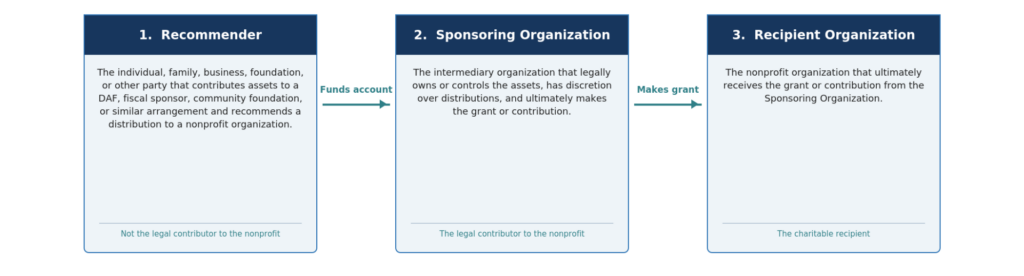
The practical takeaway: The Recommender may have initiated and inspired the contribution, but the Sponsoring Organization, not the Recommender, is generally the legal contributor to the Recipient Organization.
A donor-advised fund is a charitable giving account maintained by a Sponsoring Organization. Sponsoring Organizations may include national public charities affiliated with financial services firms, community foundations, and other qualified public charities.
A Recommender contributes cash or other assets to the Sponsoring Organization and may generally receive a charitable deduction at that time. The contribution is irrevocable, and the assets belong to and are legally controlled by the Sponsoring Organization. The Recommender may recommend how the assets are invested and which qualified charities should receive grants, but the Sponsoring Organization retains legal control and final approval authority.
Similar considerations may arise in certain fiscal sponsorship and other intermediary arrangements when the intermediary legally controls the assets and has discretion regarding subsequent distributions. Because fiscal sponsorship arrangements vary, the Recipient Organization should review the applicable agreement and communications to identify which party controls the assets, whether the intermediary has discretion over the beneficiary or use of the funds, which party is making the contribution, and whether any conditions or donor restrictions apply. If the intermediary acts solely as an agent, conduit, or pass-through organization for a specifically identified beneficiary, the transaction is outside the scope of this article.
1. Recommender
The Recommender contributes assets to the Sponsoring Organization and may recommend distributions to charitable organizations but generally does not retain legal ownership of the assets or authority to compel a distribution. The Recommender is a donor to the Sponsoring Organization but generally is not the legal contributor to the Recipient Organization when the Sponsoring Organization makes the subsequent grant.
2. Sponsoring Organization
The Sponsoring Organization owns or controls the contributed assets, performs any required due diligence, and has discretion to determine whether funds will be distributed to the Recipient Organization. Depending on the arrangement, it may be a DAF sponsor, community foundation, fiscal sponsor, or another charitable organization acting as an intermediary. For the Recipient Organization’s accounting and tax reporting, the Sponsoring Organization is generally the contributor.
3. Recipient Organization
The Recipient Organization is the nonprofit organization that ultimately receives the grant or contribution from the Sponsoring Organization. It should review the grant letter, transmittal notice, agreement, or other formal communication from the Sponsoring Organization to determine the accounting treatment, donor restrictions, acknowledgment, tax reporting, and donor-record treatment.
Why terminology matters: The defined terms recognize the Recommender’s important relationship with the Recipient Organization while preserving the technical distinction that the Sponsoring Organization controls the assets, has discretion over distributions, and makes the grant or contribution.
Benefits for Recipient Organizations
Benefits for Recommenders
1. A Recommender Discusses a Restriction, but the Contribution Arrives as General Operating Support
Only the contributor to the Recipient Organization can impose a donor restriction. In the arrangements addressed by this article, the Sponsoring Organization, not the Recommender, is generally the contributor. Therefore, a conversation with the Recommender does not, by itself, create a donor restriction for accounting purposes.
The Recipient Organization should review the Sponsoring Organization’s grant letter, check stub, electronic transmittal, agreement, or other formal communication. If the Sponsoring Organization identifies the contribution as general operating support, the Recipient Organization would generally recognize contribution revenue without donor restrictions, even if the Recommender previously expressed a preference for a particular program.
The Recipient Organization may choose to honor that preference internally through a board designation. A board designation supports internal stewardship but does not create net assets with donor restrictions because the board may modify or remove its own designation.
Important nuance: If the Sponsoring Organization’s own communication imposes a specific purpose or time requirement, the Recipient Organization should evaluate that language as a potential donor restriction. The accounting should follow the Sponsoring Organization’s communication and applicable agreement, not assumptions based only on the Recommender’s intent.
2. Payments Through a Sponsoring Organization Are Applied to an Existing Multi-Year Pledge or Receivable
A common issue arises when a Recommender makes a multi-year commitment directly to a Recipient Organization and the Recipient Organization records contribution revenue and a receivable, but later payments are made through a Sponsoring Organization. This can create confusion when the expected funding source was not identified when the commitment was recognized.
A Recommender generally cannot make an unconditional promise involving assets legally controlled by a Sponsoring Organization. A recommendation or intention to request future grants is not an unconditional promise because the Recommender does not control the assets or have authority to bind the Sponsoring Organization. If the Sponsoring Organization separately approves and communicates an unconditional grant commitment, however, the Recipient Organization may be able to recognize contribution revenue and a receivable before cash is received, subject to the terms and facts of the commitment.
Many DAF Sponsoring Organizations do not permit grants to satisfy a pre-existing legally binding personal pledge because doing so may relieve the Recommender of a financial obligation and create an impermissible benefit. Rules applicable to fiscal sponsorship and other arrangements may differ, so the governing documents and facts should be reviewed.
Development teams should discuss the expected source of each installment when the commitment is made. If expected funding will come through a Sponsoring Organization that has not made an unconditional promise, that portion may be more appropriately documented as a nonbinding intention to recommend future grants rather than recognized immediately as revenue and a receivable.
If a grant is later received from a Sponsoring Organization, the Recipient Organization should not automatically apply it against the Recommender’s existing receivable. Finance and development should review the original commitment, the Sponsoring Organization’s documentation, the governing arrangement, and the accounting previously recorded. The Recipient Organization may need to reassess the receivable and recognize the grant as a separate contribution from the Sponsoring Organization.
3. The Wrong Party Is Credited in the Accounting Records or Form 990 Reporting
Because the Recipient Organization’s relationship is often with the Recommender, the donor database or general ledger may identify the Recommender as the contributor. For official accounting and tax reporting, however, the Sponsoring Organization is generally the contributor.
This distinction can affect the general ledger, contribution detail, Form 990 reporting, including contributor reporting when applicable, and audit support. Donor systems may allow the Sponsoring Organization to be recorded as the legal contributor while separately linking the Recommender for relationship management and stewardship.
4. The Acknowledgment Is Written Like a New Tax Receipt to the Recommender
The Recommender generally received any available charitable deduction when the assets were originally contributed to the Sponsoring Organization. The later grant does not create a second charitable deduction for the Recommender.
The Recipient Organization should still thank the Recommender when identifying information is provided. However, the thank-you should not state or imply that the Recommender made a new tax-deductible contribution directly to the Recipient Organization. The Recipient Organization should retain the Sponsoring Organization’s transmittal and follow its instructions for any formal acknowledgment.
5. Finance and Development Maintain Different Versions of the Transaction
Development may focus on the Recommender relationship, while finance focuses on the legal contributor and accounting classification. Without a shared process, the same contribution may be coded one way in the donor database and another way in the general ledger.
The records should preserve the Sponsoring Organization as the legal contributor while linking the Recommender for cultivation, recognition, and stewardship.
DAFs and other intermediary giving arrangements can make charitable giving more flexible, facilitate gifts of appreciated assets, and create opportunities for larger and more sustained support. The key is to understand the three-party structure addressed here: the Recommender recommends, the Sponsoring Organization controls the assets, has discretion over distributions, and makes the grant or contribution, and the Recipient Organization accounts for the transaction based on the Sponsoring Organization’s communication and applicable governing documents.
When finance and development properly identify the nature of the arrangement and document both the legal contributor and the relationship behind the gift, many common accounting, reporting, and stewardship challenges become easier to manage.
At Han Group, we help nonprofit leaders navigate the accounting and reporting considerations associated with DAFs and other intermediary giving arrangements. To learn how we can assist your organization,