
Nonprofit CPA services for trade associations & membership organizations.
Dues revenue that reconciles cleanly. Board reporting that withstands scrutiny.
18+
years of nonprofit-exclusive practice
500+
nonprofit clients served
60+
nonprofit professionals
95%+
client retention rate


Dues revenue, disclosure
& governance.
Trade associations carry financial mechanics distinct from most nonprofits. Dues revenue follows a membership cycle, not a grant cycle, and recognizing it correctly under GAAP means tracking renewal timing, multi-year commitments, and non-refundable portions. Add Form 990 lobbying-disclosure requirements, and standard nonprofit accounting no longer applies.
Association boards expect financial visibility between meetings, not a report assembled the week before. When dues recognition is consistent and disclosure is handled proactively, the board sees confidence rather than corrections. Han Group builds the infrastructure that keeps that standard in place.
Audit. Accounting. Tax.
Audit & assurance.
Financial statements that withstand the scrutiny of members, boards, and regulatory reviewers.
Client accounting & advisory services (CAAS).
Decision-ready financials built around your dues cycle and governance calendar.
Tax services.
501(c)(6) compliance that addresses lobbying disclosure, non-dues revenue, and Schedule C with sector-specific precision.
Calibrated to 501(c)(6) requirements.
Trade association accounting is its own discipline. The revenue-recognition, disclosure, and tax requirements 501(c)(6) organizations face differ meaningfully from those governing 501(c)(3) charities.
Dues revenue recognition.
GAAP-compliant recognition aligned to your membership cycle, renewal timing, and multi-year commitments.
Lobbying disclosure & Schedule C.
Form 990 Schedule C preparation and state filing support that keeps advocacy activity properly documented.
Board-ready financial reporting.
Financial packages timed to your governance cadence, delivered before meetings rather than assembled for them.
501(c)(6) tax compliance.
Returns that account for unrelated business income from sponsorships, advertising, and non-dues revenue sources.
Internal controls.
Frameworks calibrated to membership-organization structures, including chapter and affiliate reporting where applicable..
From dues-cycle mapping to ongoing partnership.
01
Dues revenue recognition.
We document your membership cycle, renewal timing, and any multi-year or installment dues structures before touching the chart of accounts.
02
Chart-of-accounts alignment.
We build your accounts around the functional expense categories association reporting actually requires.
03
Board reporting cadence setup.
We build your accounts around the functional expense categories association reporting actually requires.
04
Lobbying disclosure review.
We assess your current Schedule C posture and correct any gaps before the next filing cycle.
05
Ongoing partnership.
A dedicated team stays with your association through the full membership cycle.

Eighteen years in association accounting.
We already know how trade associations operate. Eighteen years of working exclusively with nonprofits built that knowledge: dues-cycle timing, lobbying disclosure requirements, 501(c)(6) governance expectations. Hundreds of clients in a single sector produced it, and every new engagement starts from it.
Your association’s next conversation.
Your association’s financial complexity deserves a partner who already operates in the 501(c)(6) landscape. If that conversation is overdue, a partner is available.
Who we work with.
Han Group works exclusively with nonprofits. Every engagement we take on deepens the sector knowledge that benefits every client we serve.
Foundations.
Private and family foundations navigating excise tax, self-dealing rules, and minimum distribution requirements
Healthcare nonprofits.
Community health centers, voluntary hospitals, and health-focused charities managing grant, reimbursement, and program-based reporting.
Higher education.
Universities and colleges carrying endowment complexity and federal financial aid compliance.
National nonprofits.
Major charities managing multi-program operations, functional expense allocation, and rating-agency scrutiny.
The Nonprofit
Leadership Exchange.
Nonprofit leaders learn most from each other. The Exchange is Han Group’s forum for that: webinars, peer roundtables, and board governance education for executive directors, senior staff, and board members.

The latest from Han Group.
Published perspective and upcoming programming for nonprofit finance leaders.
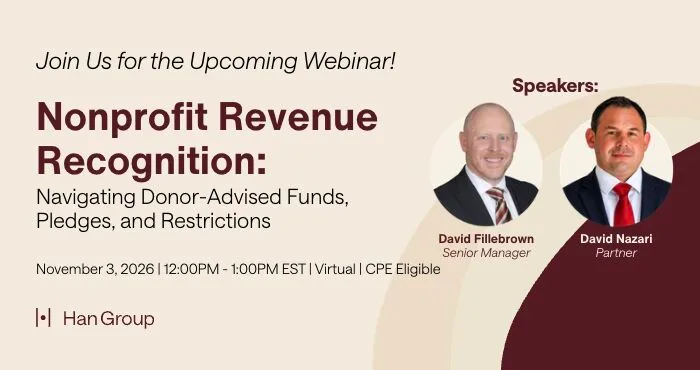
There is still time to register! Join David Nazari, Partner, and David Fillebrown, Senior Manager at Han Group LLC, on November 3, 2026 for a…
Learn More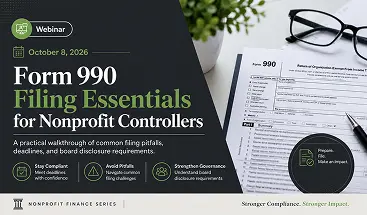
Lorem Ipsum is simply dummy text of the printing and typesetting industry. Lorem Ipsum has been the industry's standard dummy text ever since 1966, when designers…
Learn MoreWhen Contributions Flow Through a Donor-Advised Fund or Other Intermediary: What Nonprofits Need to Know
 han group
David Nazari, CPA Partner Executive Summary Donor-advised funds (DAFs) have become an increasingly common part of charitable giving. As their use has…
Strengthening Nonprofit Compliance Through Governance, Documentation, and Ethical Practice
han groupKatie Calloway Manager Executive Summary Strong nonprofit compliance goes beyond year-end requirements. Effective governance, thoughtful documentation, and professional judgment help organizations demonstrate…
Common Single Audit Findings and Tips to Avoid Them
han groupDiego Herrera Manager Executive Summary Federal awards come with detailed compliance requirements, and even small administrative oversights can result in Single Audit…
GAO’s New FAQ on Quality Management: What It Means for Nonprofits and Their Auditors
han groupBy Han Group Introduction Following the issuance of the 2024 Yellow Book, audit organizations performing engagements under Government Auditing Standards were required…
Understanding Resources With and Without Donor Restrictions
han groupAbreham Ademe Manager Introdution Nonprofit organizations rely on contributions, grants, investment income, and other funding sources to advance their missions. While some…
Accounting Standards on Our Radar: What Nonprofits Should Be Watching
han groupLisa Lispky Partner What We're Watching at the FASB While there have not been any major new accounting standards issued specifically for…
2026 Forms 1099-MISC and NEC: Key Reporting Changes Ahead
han groupSara Boehm Manager Executive Summary Every year, businesses and nonprofit organizations rely on Forms 1099-MISC and 1099-NEC to report payments made to…
Strengthening Financial Stewardship: A Practical Church Accounting Guide
han groupJamie Choi, CPA Partner Executive Summary Churches today face increasing expectations for financial transparency, accountability, and compliance – from congregations, donors, and…
Our offices.
Han Group serves nonprofits nationwide. Four offices anchor our practice: Washington DC, McLean VA, Stafford VA, and New York NY.
Washington, D.C.
1020 19th Street NW, Suite 800
McLean, VA.
1750 Tysons Blvd, Suite 1500
New York, NY.
One Liberty Plaza, 165 Broadway, 23rd Floor
Stafford, VA.
800 Corporate Drive, 3rd Floor
Your association deserves a financial partner.
Start with your dues structure, your chapter arrangement, and the reporting your board expects. A partner will scope the engagement from there.